
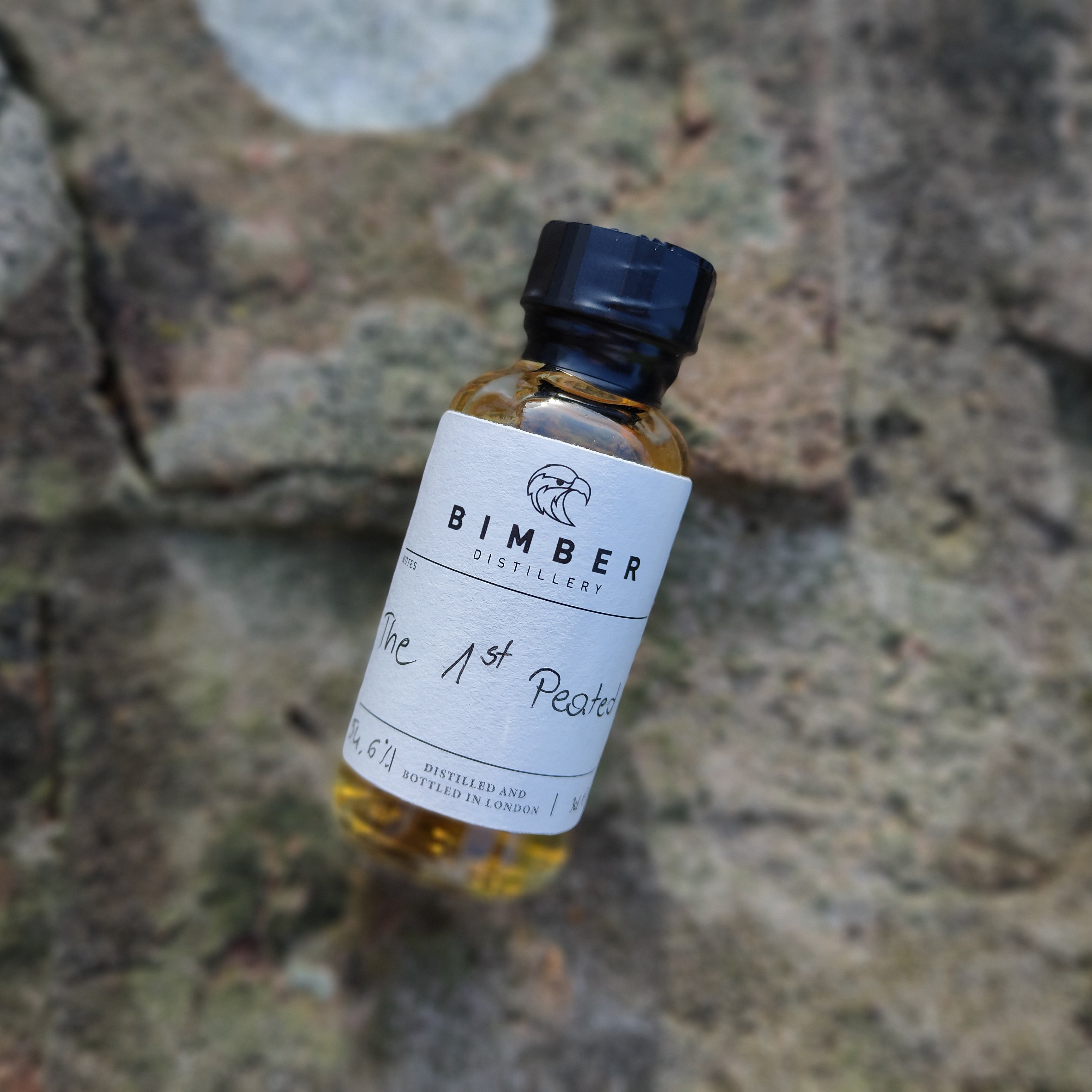
@BimberLondon has just launched their first peated barley release The 1st Peated, this come on the back of a number of masterclass bottlings which weren't released.

Let's try this first official release!
At the Southport Winter Whisky Festival in February '22 Bimber held a Masterclass where their Director of Marketing & Communications Matt McKay led us through four bottles including the two intriguing Peated releases : a virgin oak and ex-sherry.
 |
| Bimber Masterclass Bottles |
Bimber have released some peated whisky before but these have been from unpeated barley matured in ex-Islay and / or ex-Ardmore casks. These bottlings were from barley malted in Darius' basement and then dried in a home-made smoker using Highland peat to around 42ppm.
.png) |
| Diagram: Bimber |
With this their first 'proper' peated release they've followed a similar journey: back in May 2019 malted barley from Bimber's single farm supplier, Fordham & Allen in Basingstoke, Hampshire, was steeped 3 times for over 40 hours and then turned every 8 hours for the next 5 days.
It was then dried in their home made kiln using peat sourced from Aberdeenshire.
.png)
It was then mashed and fermented slowly for 7 days in open topped wooden washbacks before being distilled using the direct fire of their small copper pot stills and finally matured for just over 3 years in 4 first fill ex-bourbon casks.
Bimber have taken a different approach to explaining the PPM of their peated release - rather than trying to copy the likes of Octomore and Ardbeg who try to out do each other with high PPM barley they have made the choice to give the PPM of the final in-bottle whisky, in this case it's 14.4PPM.
Here they explain why:
Producers have sought to display the biggest PPM numbers possible without contextualising what these means in terms of the either the character of a whisky or its actual drinking experience.In nearly all cases, distilleries and producers are using PPM (parts per million) as a measurement to indicate the phenolic content of the malted barley after kilning, but before the actual whisky-making process. Notionally one would assume that the higher the PPM number, the peatier the whisky will taste. And in simple terms that’s not incorrect. However, barley PPMs ignore the fact that at every stage of the whisky-making process there is a reduction in the volume of phenols that are present.From mashing, fermentation, through distillation and maturation – PPM levels drop over time. With such incredible variance across distilleries in terms of their processes, 50 PPM barley (which is the level we peated our barley to) utilised at one distillery will not present with the same final peaty character when it is processed at another.
The actual level of phenols when in bottle will be far lower than the PPM spec of the barley – and it naturally varies from distillery to distillery. By presenting The 1st Peated with an in-bottle PPM we’re looking to kick-start a dialogue about PPMs which hopefully leads to a more considered reflection of what’s actually inside a bottle of whisky.
Distillery notes: Peated barley, Ex-bourbon matured, 54.6% ABV, 1,140 bottles
Bimber The 1st Peated is indeed a heavily peated whisky, presenting a thick layer of ashy smoke that is perfectly integrated with our in-house fruity-forward style with notes of pineapple juice, apricot cobbler, creamy toffee, feathery smoke, fallen leaves and touches of salinity on the nose. Followed by notes of smouldering logs, leaf mulch, smoked vanilla fudge, fruit and wood spice on the palate.

My thoughts:
Appearance: mid gold in the glass, swirls cling as a thin line in the glass, take a while to bead up and eventually fall as slow thick legs.

Nose: huge tropical fruit flavours to start, not much in the way of smoke, but give it a little time and air - it will start to come through. It's not heathery like Orkney peat or medicinal like Islay peat, this is somewhere in the middle - sweet and dirty. There's some salted caramel, honey and pineapple. Banana, kiwi and some wet dog notes can be found too!Palate: thick sweet arrival, chewy like most Bimbers. There's a bite of ginger spice from the ABV and then a huge blanket of sweet ashy smoke. This fades over time leaving sweet tropical fruit on the tongue: pineapple and mango. The salted caramel from the nose is back along with some lemon zest, vanilla and a hint of pine needles. There's a drying ashy smoke note let on the tongue as the liquid disappears.
Finish: Lingering smoke, sweetness and spice.Thoughts: I think I used the words Juicy Smoke for the pair of peated bottles from the masterclass at Southport and this one falls into the same category - full of juicy tropical fruit and a blanket of ashy smoke. This is better than the peated ex-sherry cask I tried but I still think that the Virgin Oak was amazing!
Giving the in-bottle rather than barley PPM is an interesting concept - for me it's only going to work if everyone starts doing the same thing - you need to be able to compare don't you? Some distilleries quote Lightly, Medium or Heavily Peated - that seems to work but the geek in me 'needs' to know the numbers! The in-bottle number is more representative of what the consumer is actually going to experience so isn't that the better way to go?
Many thanks to Bimber for the sample.
No comments:
Post a Comment